Set up a steady workspace
Knife skills begin before the first cut. Choose a cutting board large enough to hold the ingredient and leave room for the knife. Set it on a level counter, away from the edge. If it slides, place a damp towel or a nonslip mat underneath. Keep a bowl for scraps and a clear area for cut pieces so you do not have to reach around the blade.
A sharp, clean knife is easier to guide than one that needs extra force to get through food. A medium-sized chef’s knife is useful for many vegetables, but a smaller knife may feel more comfortable for small ingredients. Whichever you choose, use a blade you can control without straining your hand. Dry the handle and your hands before starting, and keep your attention on the board rather than trying to cut while distracted.
Give round foods a stable base whenever possible. For example, cut a potato in half and place the flat side down before making smaller cuts. With firm foods such as carrots, you can make a lengthwise cut to create a flat side. Slowing down to steady an ingredient is more useful than trying to work quickly while it rolls.
Hold the knife and guide the food
For a chef’s knife, try a pinch grip: place your thumb and the side of your index finger on opposite sides of the blade near the handle, then wrap your other fingers around the handle. Your fingers should stay clear of the cutting edge. This grip can give you more control over the blade than holding only the far end of the handle. If it feels awkward, practice positioning your hand while the knife rests still on the board.
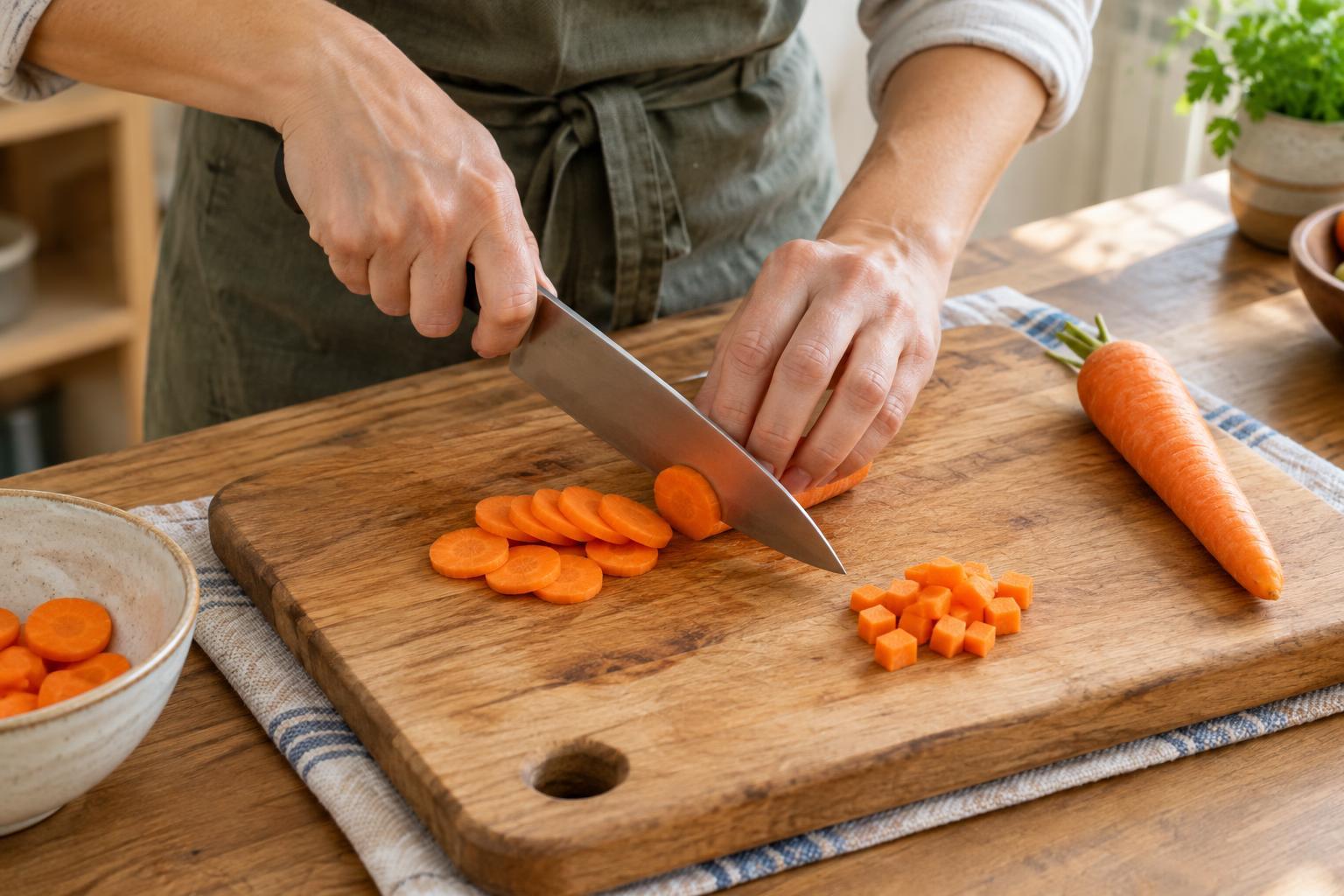
Use your other hand to steady the food. Curl its fingertips gently inward so your knuckles face the side of the blade; this is often called a claw grip. Keep your thumb tucked back rather than letting it point toward the cutting path. The side of the blade can move alongside your knuckles as you cut, while the cutting edge stays away from your fingertips. Move your guiding hand back a little at a time as the ingredient gets smaller.
Make deliberate strokes and keep the knife tip or edge in contact with the board when the cut allows it. Do not use your free hand to catch a falling piece. If food sticks to the blade, stop cutting and clear it with the knife resting safely on the board. To move chopped food, use a bench scraper or the spine of the knife rather than sweeping the sharp edge across the board.
Start with slices and strips
Slicing is a good first exercise because each cut follows the same path. Try a cucumber or a halved potato placed flat-side down. Position the knife where you want the first slice, then draw it through the food with a controlled downward motion. After each cut, shift your guiding hand back to set the next slice’s thickness. Aim for pieces that are roughly similar, not perfect.
To make strips, begin with slices that are thick enough to stay manageable. Lay one or two slices flat, stack them only if they remain stable, and cut lengthwise into strips. For a carrot, creating a flat side before slicing helps prevent rolling. Thin strips cook faster than thick ones, so choose a width that suits what you are making and try to keep it consistent.
If an ingredient becomes too small to hold comfortably, stop and set the remaining piece aside. There is no need to cut every last bit with the same technique. You can use a smaller knife when appropriate or save the piece for another preparation. Control matters more than using up every scrap.
Turn strips into dice and mince
Dicing builds on strips. Line a few strips up across the board and cut crosswise to make cubes. A small dice is useful when you want ingredients to blend into a dish; larger pieces can be easier to handle and work well when the ingredient should remain distinct. For practice, concentrate on keeping the food stable and your cuts repeatable rather than chasing an exact size.
Mincing produces finer, less uniform pieces and works well for herbs or garlic. First make several small cuts, gather the pieces into a compact pile with a scraper, then cut through them again. Repeat until they are fine enough for your recipe. Avoid pressing on the sharp edge or holding food directly beneath the blade as you gather it.
Clean the knife and board when switching between ingredients as needed, especially after handling raw meat, poultry or seafood. Wash the knife by hand with the blade facing away from your fingers, then dry it and store it where the edge will not be exposed. A careful finish is part of good knife practice.
Build confidence one ingredient at a time
A short practice session is enough. Pick one ingredient, make a few slices, turn some into strips and dice the strips. Notice whether the board shifts, your grip tightens or the pieces start to roll. Pause and adjust your setup when they do. As the motions become familiar, you can add different shapes and textures without making speed the goal.