Give your sketchbook a smaller job
A blank sketchbook can feel intimidating if you expect every page to look like finished art. Give it a different job: let it be a place to look closely, test marks and record things you notice. A crooked drawing of your coffee mug still tells you something about its shape. A page of repeated circles still counts as a page used.
You do not need to settle the question of whether you are “good at drawing” before you begin. Start by deciding what would make the book useful to you. Perhaps you want to notice details on walks, remember objects in your home or spend ten quiet minutes away from a screen. That purpose gives you a reason to open the book even when the result is messy.
Choose materials that make starting easy
Any notebook with blank or mostly blank pages can be a sketchbook. If you are buying one, pick a size you would comfortably carry or leave within reach. A small book makes quick drawings feel manageable; a larger page gives you room to experiment. Neither is the correct choice. A pencil and an eraser are enough, though a pen can be useful if erasing turns into a way to avoid moving on.
Keep your first setup simple so you can start without arranging supplies. Put your book and drawing tool together in a spot you use often. If you want to try color, add one or two colored pencils rather than waiting for a complete set. You can always change materials after you have learned what you enjoy using.
Fill the first page without making a masterpiece
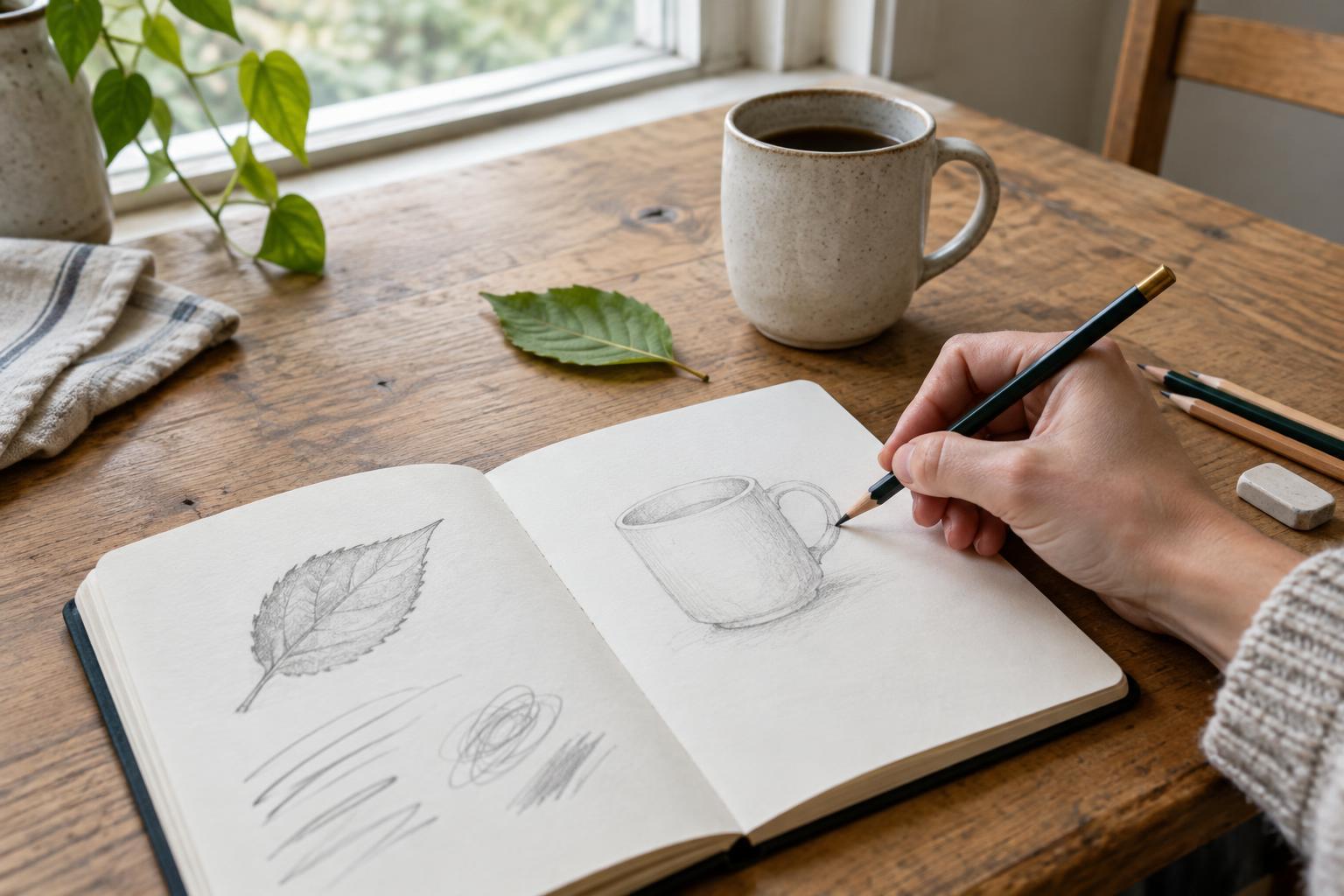
The first page does not have to introduce your best work. Try making it a practice page: draw ten short lines, ten long lines, a few loops and a row of small boxes. Then write the date or a brief note about where you are. You have turned a precious blank book into a working one.
For your next page, choose a familiar object that can sit still, such as a spoon, key or shoe. Look at its outer edge and draw that outline slowly. If a line goes somewhere unexpected, keep going. Add a second drawing beside it and notice what you saw differently the second time. The goal is not an exact copy; it is to spend a few minutes paying attention.
Use small exercises when you feel stuck
When you do not know what to draw, set a modest limit. Draw three objects on your desk in five minutes, or fill half a page with different versions of one leaf. You can also draw without lifting your pen, letting the line travel around an object until you decide to stop. These constraints give you something specific to do and leave less room for judging each mark.
Words can share the page with pictures. Label a shape you found tricky, note the color of a shadow or write down what made you choose the subject. If a drawing feels confusing, try breaking the object into simpler parts: an oval for a cup opening, two lines for its sides and a curve for its base. These are tools for seeing, not rules your sketch must obey.
Make the habit fit your real life
A sketchbook habit can be brief and irregular. You might draw while water boils, during a lunch break or after a walk. To make choosing a subject easier, keep a short list inside the back cover: something on a shelf, a view from a window, a hand holding an object, or a detail you noticed outside. On days when you have more time, return to a subject you drew before and see what else you notice.
Try not to judge the whole book by any single page. Some pages may be experiments you never repeat; others may suggest an idea you want to explore further. If it helps, mark pages you enjoyed making rather than only pages you think look successful. Over time, your sketchbook can become a record of what caught your attention—and a reliable place to begin again.