Why temperature beats appearance
Color, texture, and cooking time can offer clues, but they cannot reliably tell you what is happening at the center of a food. A chicken breast may look browned outside while its thickest part needs more time. A burger can brown before its middle reaches a safe temperature. A thermometer lets you check the part that matters instead of guessing or cutting food open repeatedly.
An instant-read thermometer is a useful starting point for most home cooks. Insert its probe when you want a reading, then remove it before cooking continues unless the product is specifically designed to stay in the food. A leave-in thermometer can help you monitor a roast while it cooks. Whichever type you use, keep its instructions handy: models differ in how deeply the sensing tip must be inserted and how long a reading takes to settle.
Put the probe in the right place
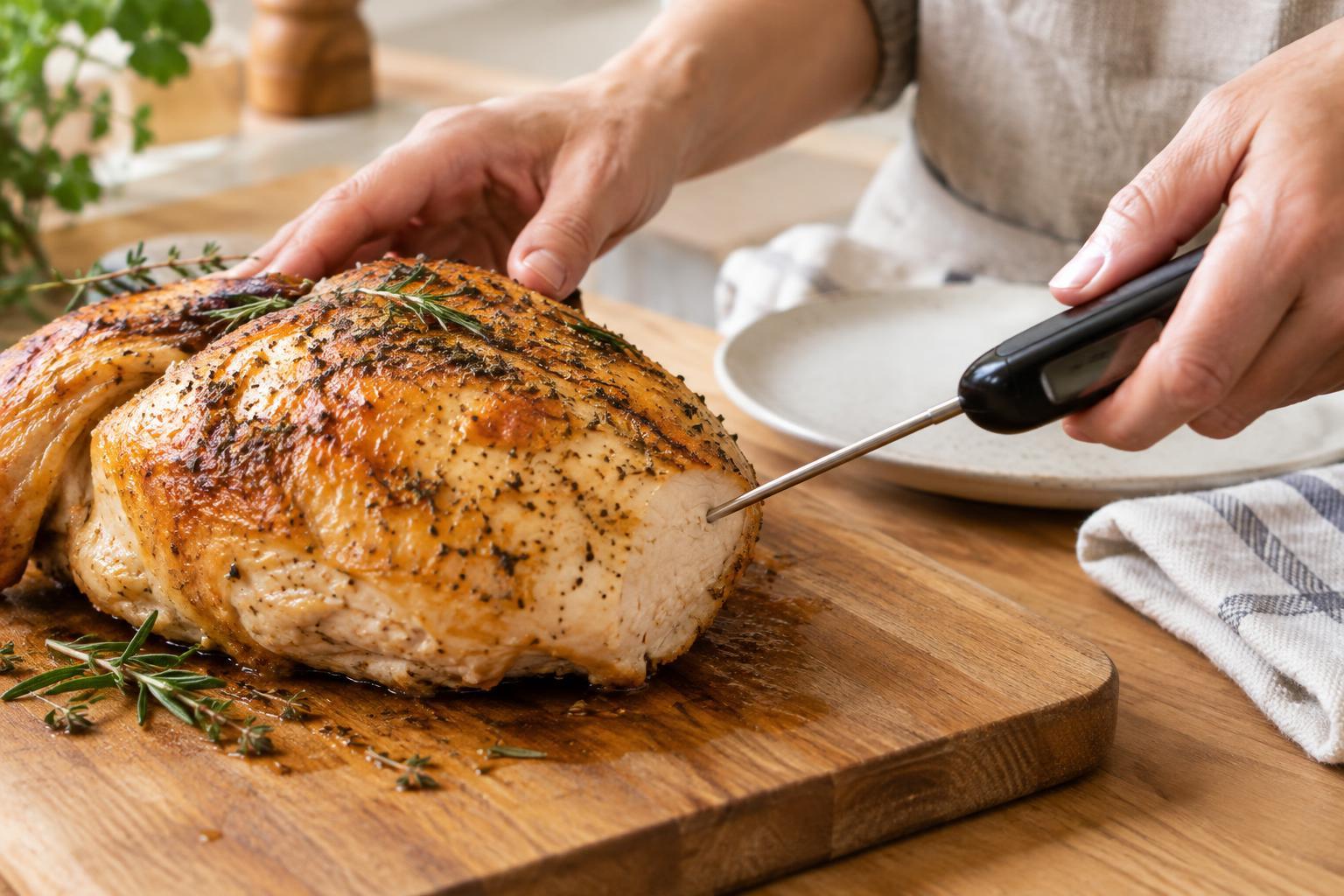
Aim for the thickest part of the food, usually near its center. Keep the sensing area away from bone, large pockets of fat, gristle, and the pan, which can give a misleading reading. For a roast or a thick chicken breast, insert the probe from the side or top far enough to reach the middle. Check more than one spot if the piece is unevenly shaped; the coolest reading is the one to pay attention to.
For thin foods such as a burger patty or fish fillet, insert the probe sideways so the sensing area sits in the center rather than passing through to the hot pan. With a whole bird, check the thickest part of the breast and the innermost part of the thigh without touching bone. If the display changes as you move the probe, pause at the coolest central spot and wait for the reading to stabilize.
Know the target before you cook
Different foods have different recommended minimum internal temperatures. Common U.S. food-safety targets are 165°F (74°C) for poultry and reheated leftovers, 160°F (71°C) for ground meats such as beef, and 145°F (63°C) for fish. Whole cuts of beef, pork, lamb, and veal have a commonly recommended minimum of 145°F (63°C) followed by a three-minute rest. If you follow guidance from another region, check its recommended targets, which may differ.
Choose the target for the actual food, not just how you prefer its color. Ground meat needs particular attention because grinding mixes the surface into the interior. Stuffed foods, mixed dishes, and foods containing several ingredients can be harder to judge from appearance; use a temperature target appropriate to the dish and check its center. If you are cooking for someone at higher risk of foodborne illness, follow the guidance appropriate to their circumstances.
Check at the right time and allow for resting
Start checking shortly before you expect the food to be done, using a recipe’s cooking time as a reminder rather than a guarantee. Oven performance, food thickness, and starting temperature all affect how long cooking takes. If the reading is below the target, continue cooking and check again after a short interval. Repeatedly opening an oven or grill can slow cooking, so give the food time to make progress between checks.
Temperature can continue rising after food comes off the heat, especially in a large roast. This is called carryover cooking. It can help prevent overcooking when you plan for it, but do not assume the temperature will rise by a particular amount. Check again during the rest if you are relying on carryover to reach a target. Resting also gives juices time to settle; for whole cuts that call for a three-minute rest, include that step rather than serving immediately.
Keep the thermometer clean and trustworthy
Clean the probe according to its instructions after it touches raw food and before using it on cooked food or another ingredient. This prevents the thermometer from transferring raw juices to food that is ready to eat. Wash your hands and avoid setting a used probe on a clean plate. Many thermometer displays are not waterproof, so check the care instructions before rinsing the whole device.
If readings seem implausible, check that the probe is fully inserted and not touching a hot surface or bone. You can also test many thermometers in a tightly packed ice-and-water mixture: a stable reading should be near 32°F (0°C). Follow the manufacturer’s directions if your model can be calibrated. A reliable thermometer, placed carefully and kept clean, turns doneness checks into a quick habit rather than a cooking-day guessing game.